
2021 in Books

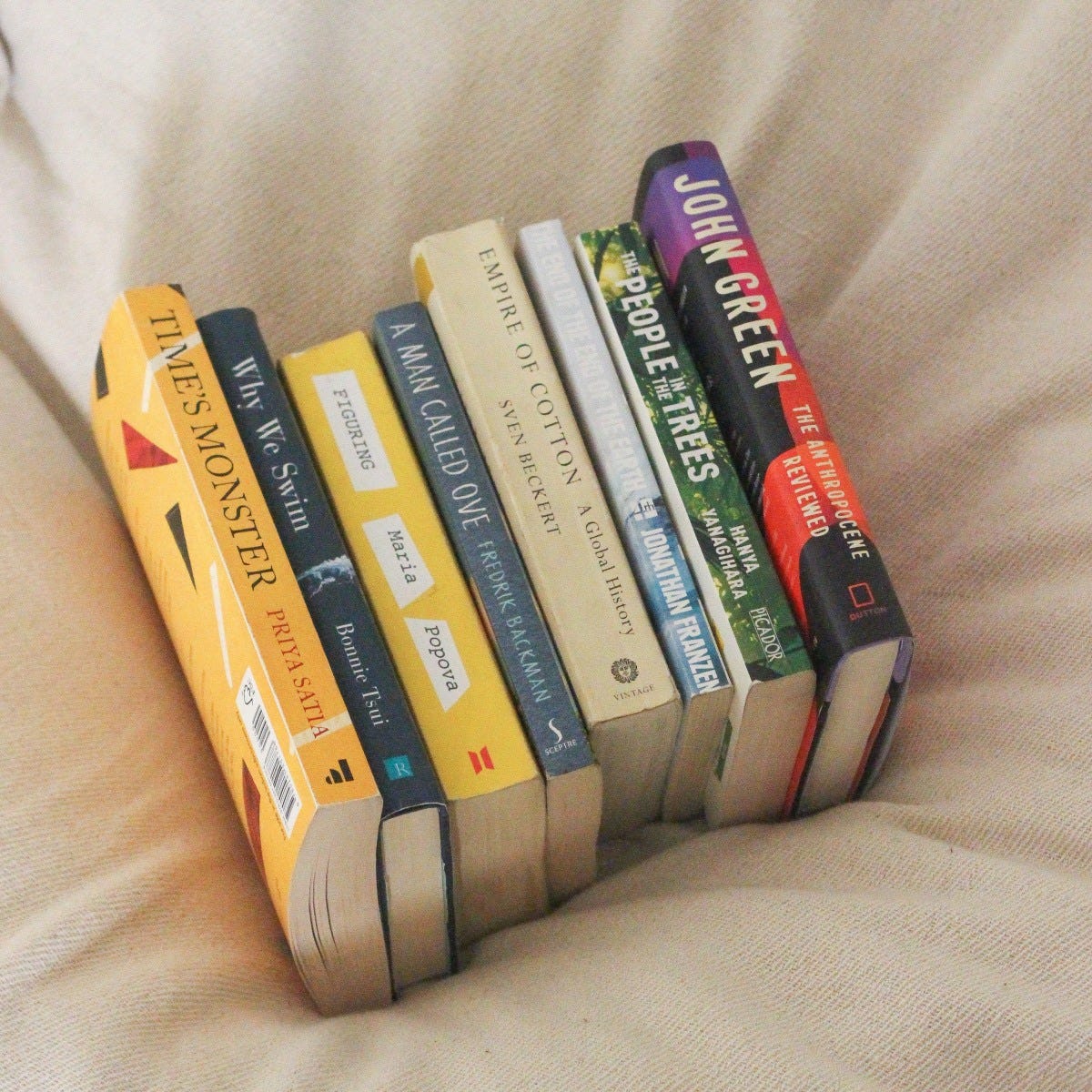
A non-fiction-heavy year. Lots of essays, lot of history, some crime. Another Yanagihara, a Rooney (but not the one you think). A new release and pandemic writing. Here are all the books that stood out in this ten-year-long seven seconds of a year.
Non-fiction
Figuring by Maria Popova (2019)
“Lives,” writes Maria Popova, “are lived in parallel and perpendicular, fathomed nonlinearly, figured not in the straight graphs of ‘biography’ but in many-sided, many-splendored diagrams.” In the pages that follow, Figuring weaves its many-sided diagram, encompassing four centuries and bringing together a series of interconnected lives from that of Johannes Kepler and Mary Sommerville to Margaret Fuller and Rachel Carson. The book’s prime concern is the idea that human genius is interconnected and inherently collaborative, and further one that thrives because it is interwoven so. Popova writes of genius loci – genius that resides in a place, at the intersection of history, politics, and geography – and makes a very strong case for the “collective mutuality” of human life. It is as this genius intersects that the world is figured. Tightly edited and extremely precise, Figuring never loses sight of this premise. Even as Popova sketches her figures as complicated and contradictory individuals, she is acutely aware of everyone’s place in the human project that works to understand the world. Quite simply, reading Figuring is exciting. It is exhilarating to watch ideas unfurl and reach out through history. Popovapushes the reader to imagine more, and to imagine creatively, pushing the bounds of how stories can be told simply by existing.
The Anthropocene Reviewed by John Green (2021)
Green’s podcast, where he reviews human-made things on a five-star scale, is at once transcendental and banal – a sentiment the book carries forward exceedingly well. If you are, like me, a regular listener of the podcast, chances are you already know exactly what reading The Anthropocene Reviewed is going to be like, and in that sense, reading the book is like navigating a deeply familiar territory. Where the book departs from the podcast is in its awareness of the pandemic. As it mourns the loss of the overcrowded Indy 500, of whispering, and of a great deal of human activities lost in socially distant times, and as it frets over the anxiety of living through a plague, TAR is laced with the doom of the pandemic. But at the same time, in its celebration of the human capacity for wonder, in our temporal range, in our incessant inventiveness, it is also a book that carries hope coloured – and arguably, humbled – by the pandemic. It works through volumes of human-made things, big and small, to make you aware of your mortality in the best possible ways. Green is nothing if not aware of human myopia, but with Reviewed, he also makes a case for the sheer imaginative power that propelled humanity from foraging for food to playing videogames. And in that sense, Reviewed is Green’s most honest work yet as it leans fully into all that is vulnerable about being a person and takes slow-moving yet confident steps to navigate what the other Green called “a beautifully foolish endeavour”.
The End of the End of the Earth by Jonathan Franzen (2018)
Franzen’s essay-collection walks a tightrope as it both accepts the inevitability of climate disaster and finds ways to prepare for it. It is a complicated position not only to maintain but also to articulate, but it is one Franzen has maintained consistently, arguing that facing the inevitability of a climate-changed-future is far better than denying it, than continuing to hope, year after year, for a total reversal of lifestyles or a total phasing out of coal or oil. The essays – from ‘Save What You Love’ to ‘Invisible Losses’ to the eponymous penultimate one – all circle back the climate crisis being a “done deal”, yet the collection is far from cynical and Franzen has far from given up. If anything, it is precisely by refusing to hope for change that The End sets itself free to find things worth living for. Meaning and hope exist because we’re here now, and we’re alive. It is an elegant collection, one that works through its thoughts with the reader, gently pushing and probing, always aiming to find answers, but also perfectly happy with returning to the question some other day.
Empire of Cotton by Sven Beckert (2014)
In Empire of Cotton, Beckert turns to cotton and its global spread as symbolic of the growth of not only global capitalism, but also colonization, imperialism, and much of modern industrialisation. Cotton, the book argues, is irrevocably tied with the development of the modern world as we know it, and it is through a study of cotton that the violence of modernity can be assessed. Beginning with the earliest clusters of cotton production in South and Central Asia, and the Americas, Beckertthen goes on to trace the progress of a global interconnected system of cotton manufacture with Europe at its core. The book belongs to a long list of academic scholarship that explores the development of global capitalism and what is called the Great Divergence debate – the question of how Europe (and in a larger sense the West) became rich starting in the 18th and 19th centuries, while the rest of the world did not. Based on the argument that for centuries, the relative wealth and ‘standard of living’ in the East and the West had been comparable and largely similar, the Great Divergence debate looks to answer the question of what led to this extremely wide divergence in the respective destinies of the West and the East (or alternatively, as Beckert shows, the Global North and the Global South). Empire of Cotton tells a monumental story, and it is a heavy work both in terms of research and its arguments. Yet at the same time, it is also a book, like other recent commodity-centred histories – and arguably because it is one – that has the potential to build bridges between academic and popular history.
Time’s Monster: History, Conscience and Britain's Empire by Priya Satia (2019)
Satia’s history is the history of how the British Empire was imagined and perpetuated by the very existence of historical thought in imperial Britain. Beginning with the likes of Sir William Jones and the father-son Mill duo, Satia takes a look at how historicism took shape in Britain in the interaction between the colonies and the British metropole. Rather than being a straightforward history, Time’s Monster goes back and forth between historical thought, ethical systems, and practical material concerns of colonial-imperial rule. It is a complex book, but one that is elegantly built and delivered. What is perhaps the most remarkable thing about it is that is works to shift the debate surrounding colonization from the so-called ‘balance-sheet’ approach to discussing more precise questions regarding the logic of colonial rule and thought.
Why We Swim by Bonnie Tsui (2020)
In Why We Swim, author Bonnie Tsui brings together a host of scientific, cultural, and historical evidence, as well as lived experience, to answer the eponymous question. The book is as much Tsui’s journalistic inquiry as it is a personal exploration of swimming. The story Tsui wants to tell is divided thematically, each providing a lens through which we might understand the reasons for swimming – survival, well-being, community, competition, and flow. But at the same time, these themes flow into each other. Survival is linked to well-being as much as it is about competition or the community. Drawing on her own experience as well as those of Olympic swimmers, Tsui makes a case for the elemental force of competitive swimming that turns swimming into an exercise in self-improvement – one that exists, most importantly, for you and only for you. Why We Swim is fascinating also because it brings to notice the million ways in which people relate to water. There are myths and stories woven into cultures, stories that both revere the sea and alert people to its dangers. These stories are how societies build in an awareness of the sea, something that in today’s time of rising seas, is a question of survival in coastal societies. More importantly, this awareness also enables people to live withwater. Such stories are, for Tsui, reminders that “we are not so far removed from the sea”. There is a lot of poetry to Why We Swim, especially in her insistence on the awe-inspiring potential of water. “Beauty is terror,” Donna Tartt said in The Secret History, and Tsui agrees: the ocean might be a scary place, but that is exactly why it is so seductive. Tsui’s love for swimming permeates the book, and while my love for the book has in part to do with my love for swimming, Why We Swim is a truly charming book. Tsui finds ways to translate her love into a universal one, her personal quest for answers into universal queries. “Not everybody is a swimmer,” Tsui reminds us; “but everyone has a swimming story to tell.” Why We Swim is a reminder to look for that story.
Fiction
The People in the Trees by Hanya Yanagihara (2013)
Yanagihara’s debut tells the story of immunologist Dr Abraham Norton Perina’s dramatic rise and fall in the aftermath of his ‘discovery’ of an allegedly immortal Micronesian tribe. At the same time, through its story of a contact between the West and a ‘primitive’ land, The People in the Trees also explores larger themes of moral relativism (or lack thereof) and the ecological imperialism and exploitation carried out in the name of science. From the get-go, Yanagihara’s narrative is unnerving. For one, it begins with the odds stacked against its protagonist: Perina is convicted of sexual assault and rape of his adopted children. Then there is the sense of impending doom that is laced throughout the prose and which comes from what is now a deep familiarity with the narrative of colonialism. Yanagihara harnesses this familiarity to make her point, to make every development that much more complex and that much more morally charged. The People in the Trees is as unsettling as it is enthralling, and with its uncannily detailed descriptions of its island’s natural world and the tribe’s lifestyle – not to mention its eerie, almost thriller-like unraveling – it is a novel you admire more than a novel you love.
Broken Harbor by Tana French (2012)
If The People in the Trees’ violence is systemic and almost inevitable, Broken Harbor’s violence is both everyday and surprising. Set in a now-abandoned suburb built during an economic boom on the outskirts of Dublin, Broken Harbor opens with a triple murder in the Spain family. The children have been smothered in their beds, and the father stabbed to death, while the mother – Jenny Spain – fights for her life in the hospital. This fourth instalment in her Dublin Murder Squad Series is narrated by the case’s lead detective Mike ‘Scorcher’ Kennedy, and works, like the rest in the series, on a psychological, character-driven level. French’s murder is far from simple: the Spains only grow more mysterious the more we know about them, slowly drawing in everyone from extended family to childhood friends. Then there is the detective himself, who is battling his own demons. In a word, Broken Harbor is chilling, drawing in underlying tensions of the recession-hit suburb (and, by extension, Dublin), and with its uncanny symmetry and extremely seductive prose, the best one in French’s six-part series.
Conversations With Friends by Sally Rooney (2017)
Rooney is better known for her incisive Normal People and her newest release that dots bookstores, Beautiful World, Where Are You. My favourite Rooney, however, is the oldest Rooney. Conversations follows two college friends, Bobbi and Frances, through the ups and downs of their relationship as they navigate early adulthood with each other. During one of their joint poetry performances, they meet photographer and writer Melissa who wants to run a profile on them. The two soon find themselves becoming increasingly involved with Melissa and her husband Nick, especially as Frances and Nick soon begin an affair. Unravelling between Ireland and Europe, Rooney’s story of adultery is fairly straightforward, and her characters do as well as they can with the space given to them. What makes Conversations remarkable then, is the fact that it works almost entirely on the basis of, well, conversation. Dialogues bounce off each other, and Rooney plays with her group’s dynamics with the same ordered precision that marks her later works, creating prose that is easy (if not too simple) to read. Conversations’ pivot, however, is Frances and Bobbi’s friendship, which is as electric and consuming as it is soft and calm. And it is ultimately the story of a friendship that makes this novel such an endearing one.
A Man Called Ove by Fredrik Backman (2012) (trans. Henning Koch)
Primarily set over the course of three weeks, A Man Called Ove follows the eponymous Ove, a fifty-nine-year-old man who is as eccentric as they come. he spends an hour every morning walking around his neighbourhood, checking if the road signs are in place, if everyone’s garages and the parking space is securely locked, whether all vehicles are where they’re supposed to be – not because he has nothing else to do, but because someone has to keep the world in place and he has to do it because no one else will. He doesn’t talk much – he can’t be bothered, because people are a waste of time, and a man is known by what he does, not what he says. Yet for all his eccentricity, Ove eludes simple description. He is not your grumpy cynic. Neither is he a finnicky old man. It is easy to invest in the portrait Backman builds, balancing incredulity and plausibility in a precise mix to deliver 300 pages of the most heart-warming story I read this year.